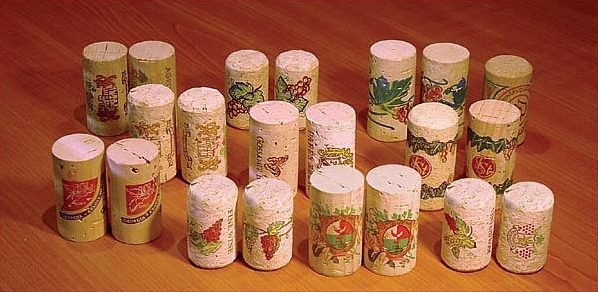
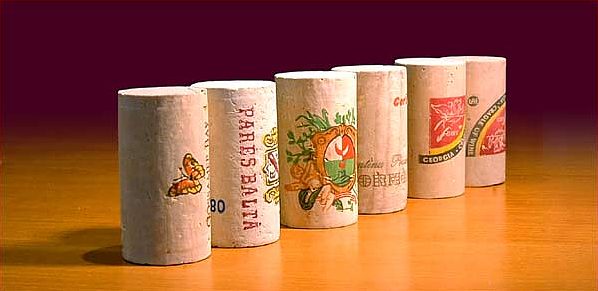
Industrial color printing on cork stoppersInvestor: Stanimirov Cork Industry LDA Portugal
Project
Development of technology and machine for industrial color printing on cork stoppers.
Challenges
Attempts for the creation of such technology have been made, but without result. Why?
In order to aim our work in the right direction, we first had to clarify the following issues:
- What are the possibilities of the existing printing technologies for applying of quality multicolor image on cylindrical surface?
- What are the specific physical-mechanical features of the stoppers of natural cork?
- What type of print is most suitable from a printing point of view?
Existing technologies up to the moment
The general technical principles characterizing the existing equipment for applying of multicolor image on cylindrical surface up to this moment may be summarized according to the following features:
- The separate colors are applied consecutively on separate color stations;
- It is necessary to maintain exact angular orientation of the print object in relation to the printing elements for each primary color;
- Provision of rotary movement with sufficient kinematic accuracy during the roll-over of the print object in the printing element.
Requirements to the print object for the existing technology level
The summarized requirements to the print object are:
- the object should have smooth, clean, light and geometrically exact cylindrical surface;
- the object should have the necessary dimensional stability providing for multiple force impact on it without provoking lasting deformation of its structure.
What are the specific physical-mechanical features of the stoppers of natural cork?
- Different density and hardness of separate zones of the circular surface;
- Presence of cracks and hard spots;
- Impossibility to produce calibrated cylindrical articles of natural cork due to the reasons listed above. Characteristic for them are deviations from circularity and cylindricality;
- High surface dust load due to the micro-porous structure and methods used for mechanical processing (cylindrical surface grinding);
- Lasting residual deformation in the structure is provoked by exercising of force action on them.
Why do the existing methods not lead to the desired result?
It is evident that in the production of stoppers from natural cork, which is a natural material, these structural particularities are not subjected to production control or correction and for each sample their combination is unique.
This is the main reason for non-applicability of the known methods and machinery for multicolor print on cylindrical surface in the case of natural cork and cork mixtures stoppers. Such experiments have been carried out, but ended quite unsuccessfully due to the following reason.
The force action of the printing profile on the print object results in an uncontrolled displacement of the work position due to the provoked residual deformation in the structure of the natural cork. It is a matter of fact from technical point of view that in the consecutive passing through the separate color stations the angular kinematic error between the print object and the printing elements of the separate colors will increase that makes impossible the synthesis of a quality multicolor image.
What type of print is most suitable from a printing point of view?
The branch experience indicates that where printing on cylindrical stoppers of natural cork and cork mixtures is concerned, the only method of practical value for industrial application is the contact “relief print” method.
- The relief printing profile minimizes the contact area providing the possibility to achieve the necessary local surface deformation for relatively less force action in order to eliminate the geometrical errors, roughness and zones with different hardness;
- The relief printing profile allows simultaneous and direct contact of all printing elements with the print object improving the force balance in the work position in their opposite arrangement;
- The printed image is color-intensive and erasure-resistant due to the deeper penetration of the ink layer in the microporous structure in case of pressure;
- Great operational reliability of the process due to the lower contamination of the printing profile. It is due to the sucking effect of the microporous structure during the detachment of the printing profile;
- Big operational capacity of the printing profile because of the relatively high relief.
Conclusion
It is clear from the stated above that in order to create an industrial technology for the realization of this new product the contact method relief printing type should be used, but in such a way that the kinematic error resulting from the residual deformation in the cork structure will not accumulate.
How can these contradicting requirements be combined?
Solution
It is possible by the method developed by us for simultaneous and direct application of the primary colors on the cylindrical surface of natural cork and cork mixtures stoppers during a 360° synchronous rotation of the print object and printing elements. This method is unique in the printing technique and is recognized as an invention along with the unique machine realizing it.
Result
The invention is complex and comprises three independent patented inventions:
- Method for printing of multicolor images on non-sized cylindrical surfaces;
- Machine for printing of multicolor images on non-sized cylindrical surfaces, including on cork stoppers;
- Cork stopper with a machine-applied multicolor image on it.